


Solar Reflectance – Why It Matters in Healthcare
- Dimitri

- Jan 5
- 7 min read
More than 60 percent of British healthcare facilities face rising energy costs tied to inefficient building materials. For European managers, creating healing environments now means blending patient recovery with sustainability goals. Understanding solar reflectance in lighting helps you choose surfaces and materials that boost energy efficiency, elevate comfort, and support compliance with strict green building standards.
Table of Contents
Key Takeaways
Point | Details |
Understanding Solar Reflectance | Solar reflectance is crucial in healthcare lighting, directly affecting energy efficiency, thermal loads, and patient comfort. |
Material Selection Impact | High-reflectance materials should be prioritised in healthcare facilities to optimise temperature control and reduce cooling energy needs. |
Measurement Techniques | Accurate measurement of solar reflectance is essential for evaluating building materials, utilising advanced methods like reflectance spectroscopy. |
Economic and Environmental Benefits | Effective solar reflectance design can lead to significant energy savings and enhances the sustainability of healthcare environments. |
What Is Solar Reflectance in Lighting?
Solar reflectance represents a fundamental optical property that describes how surfaces interact with sunlight, specifically measuring the fraction of incident solar radiation that gets reflected back into the environment. In healthcare lighting design, this phenomenon becomes critically important for managing thermal loads, energy efficiency, and patient comfort. Solar reflectance is quantified on a scale from 0 to 1, where higher values indicate greater sunlight reflection and lower heat absorption.
At its core, solar reflectance involves understanding how different materials and surface properties manipulate light wavelengths, including ultraviolet, visible, and infrared components. The complex interaction between surfaces and solar radiation determines not just thermal characteristics but also impacts visual comfort, energy consumption, and environmental sustainability within healthcare spaces. Surfaces with high solar reflectance can significantly reduce heat gain, creating more stable and comfortable interior environments.
Healthcare facility managers must consider multiple factors when evaluating solar reflectance, including surface colour, texture, material composition, and geographical location. Different materials exhibit varying reflective properties: light-coloured glass and specialised cladding can reflect up to 80% of incoming solar radiation, while darker surfaces might absorb substantially more heat. This variance directly influences interior temperatures, lighting requirements, and overall energy performance of medical buildings.
Here is a summary of key factors influencing solar reflectance in healthcare facilities:
Factor | Impact on Reflectance | Effect on Facility Climate | Typical Examples |
Surface Colour | Light colours reflect more | Lower heat absorption | White roofing, pale cladding |
Texture | Smooth increases reflection | Stabilises internal temperatures | Polished glass, coated metal |
Material Composition | Some materials reflect more | Enhanced energy efficiency | Metal panels, treated glass |
Geographical Location | Sun intensity affects needs | Varies cooling/heating demands | Equatorial vs. temperate sites |
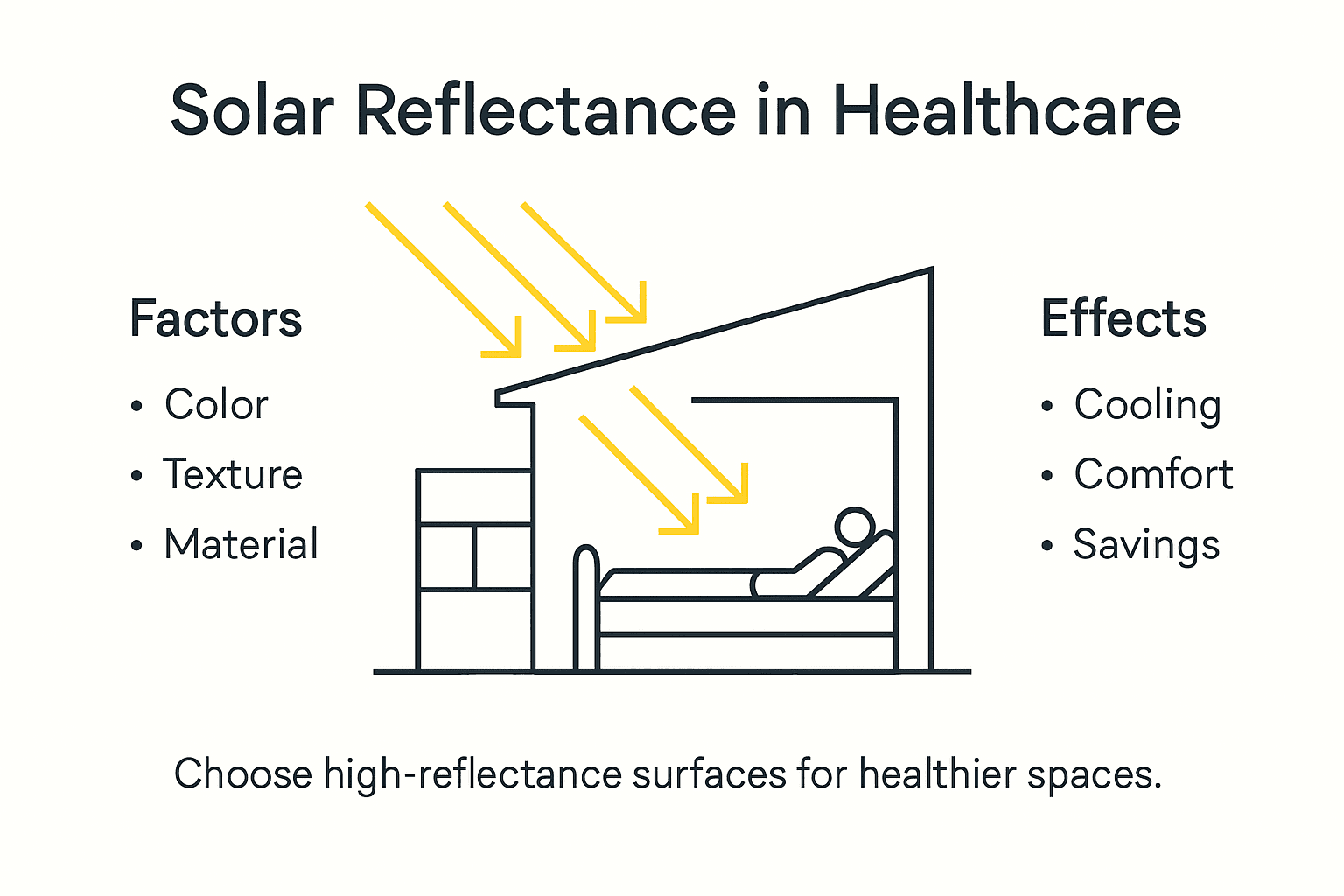
Pro tip: Prioritise light-coloured, high-reflectance materials for exterior surfaces in healthcare facilities to optimise thermal performance and reduce cooling energy demands.
Major Types and Measurement Methods
Solar reflectance measurement involves several sophisticated techniques that capture different dimensions of light interaction with surfaces. Reflectance spectroscopy represents a powerful non-destructive method for assessing material properties across ultraviolet, visible, and near-infrared wavelengths. Healthcare facility designers can leverage these techniques to understand precise optical characteristics of building materials, ensuring optimal thermal and visual performance.
The primary types of solar reflectance include hemispherical reflectance, which measures total reflected light across all angles, and specular reflectance, which captures mirror-like reflection at specific incident angles. Specialized instrumentation like spectrophotometers with integrating spheres enable precise measurements of these complex optical properties. Researchers can also conduct solar-weighted reflectance measurements that account for the energy distribution within the solar spectrum, providing nuanced insights into material performance.
Measurement methodologies in healthcare contexts require rigorous calibration and standardised procedures. Instruments must account for variables such as surface texture, material composition, and environmental conditions. Advanced techniques now allow for detailed characterisation of reflective properties, enabling healthcare facility managers to select materials that optimise thermal comfort, energy efficiency, and patient well-being. These measurements help predict how different surfaces will interact with sunlight, ultimately influencing interior climate control and sustainable building design.
This comparison clarifies major solar reflectance measurement methods used in healthcare design:
Method | Key Wavelengths Analysed | Main Advantage | Common Application |
Reflectance Spectroscopy | UV, visible, infrared | Comprehensive, non-destructive | Material selection process |
Spectrophotometer with Integrating Sphere | All angles and spectra | Precise measurement across angles | Laboratory performance tests |
Solar-Weighted Reflectance | Solar energy spectrum | Computes real-world solar impact | Predicting facility cooling |
Pro tip: Invest in professional spectrophotometric analysis when selecting exterior materials for healthcare facilities to ensure precise understanding of solar reflectance characteristics.
How Solar Reflectance Works in Practice
Reflectance spectroscopy demonstrates how light interaction with surfaces provides critical insights into material and environmental characteristics. In healthcare settings, this technique goes beyond simple visual assessment, enabling precise analysis of how different surfaces interact with solar radiation. The process involves illuminating a surface and measuring the wavelengths and intensity of light reflected back, which reveals complex information about thermal absorption, material composition, and energy performance.
Practical applications of solar reflectance in healthcare facilities extend far beyond theoretical measurements. Specialized measurement techniques allow facility managers to predict and optimise building performance by understanding how different materials will respond to solar radiation. This includes selecting exterior cladding, window treatments, and roofing materials that can dramatically reduce heat absorption, minimise thermal stress on building structures, and create more comfortable internal environments for patients and staff.
The intricate science of solar reflectance involves understanding how surface properties such as colour, texture, and material density influence light reflection. Different wavelengths interact uniquely with surfaces, creating complex patterns of absorption and reflection that can be precisely mapped using advanced spectrophotometric equipment. Healthcare designers can leverage this knowledge to create buildings that not only look aesthetically pleasing but also perform efficiently, reducing energy consumption and creating more sustainable medical environments.
Pro tip: Conduct comprehensive solar reflectance assessments during the design phase to identify materials that will optimise thermal performance and patient comfort.
Healthcare Benefits: Recovery, Savings, Sustainability
Exposure to sunlight offers profound healthcare benefits that extend far beyond simple illumination. Natural light plays a critical role in patient recovery, influencing physiological processes such as vitamin D synthesis, mood regulation, and circadian rhythm management. Healthcare facilities that strategically implement solar reflectance technologies can create environments that actively contribute to patient healing and well-being, transforming passive spaces into active therapeutic tools.
The economic implications of intelligent solar reflectance design are substantial. By optimising natural light entry and thermal management, healthcare facilities can achieve significant energy savings, reducing artificial lighting and heating costs. Advanced light therapy techniques demonstrate how specific light wavelengths can support medical treatments, potentially reducing recovery times and minimising pharmaceutical interventions. These approaches not only decrease direct healthcare expenses but also align with sustainable medical infrastructure development.
Sustainability in healthcare goes beyond energy conservation. Thoughtful solar reflectance design contributes to broader environmental goals by reducing carbon footprints, minimising artificial resource consumption, and creating healing spaces that are in harmony with natural cycles. By integrating advanced reflective technologies, medical facilities can demonstrate leadership in ecological responsibility while simultaneously improving patient outcomes and operational efficiency.
Pro tip: Conduct a comprehensive solar reflectance assessment during facility design to maximise natural healing environments and long-term energy efficiency.
Compliance: Standards, Pitfalls, and Alternatives
The Solar Reflectance Index (SRI) standard provides critical guidance for healthcare facility designers seeking to implement sustainable lighting solutions. This comprehensive framework combines measured solar reflectance and thermal emittance to establish precise performance benchmarks for building materials, ensuring that healthcare infrastructure meets increasingly stringent environmental and energy efficiency regulations. The standard serves as a crucial tool for mitigating urban heat island effects and promoting sustainable architectural practices.
Standardisation in solar reflectance measurement involves navigating complex technical challenges, including instrument variability and methodological inconsistencies. Healthcare facility managers must be aware of potential measurement pitfalls that can compromise accurate assessment of material performance. These challenges include variations in spectrophotometric equipment, differences in calibration protocols, and the complex interactions between surface properties and light reflection across different wavelengths.
Alternative approaches to traditional solar reflectance compliance are emerging, leveraging advanced modeling and imaging technologies that provide more nuanced insights into material performance. These innovative methods allow for more precise prediction of thermal behaviour, energy efficiency, and environmental impact. By embracing these sophisticated assessment techniques, healthcare facilities can move beyond simple compliance to achieve holistic sustainability goals that balance patient comfort, energy conservation, and environmental responsibility.
Pro tip: Engage independent experts to conduct comprehensive solar reflectance assessments, ensuring rigorous compliance and identifying innovative design opportunities.
Harness Solar Reflectance to Transform Healthcare Environments
The article highlights the vital challenge healthcare facilities face in managing solar reflectance to control heat absorption, reduce energy costs, and improve patient comfort. Your facility may struggle with excessive thermal load, inefficient lighting, or poor natural light exposure—all factors that impact patient recovery and staff well-being. Concepts such as light-coloured surfaces and reflectance spectroscopy emphasise the need for precise, sustainable solutions that balance energy efficiency with healthcare benefits.
At Light Mirror we provide innovative sustainable lighting solutions that address these exact challenges. Our proprietary system uses advanced reflective panels guided by AI algorithms and environmental monitoring to optimise daylight entry. This approach reduces reliance on artificial lighting and cooling while enhancing natural light exposure to improve health outcomes. Discover how our technology aligns with green building standards and supports your goals for energy savings, patient comfort, and sustainability.
Explore how reflective surface optimisation can transform your healthcare space by visiting Light Mirror’s homepage. Ready to redefine your facility’s lighting and thermal performance? Contact us today for tailored feasibility studies and full system support to make solar reflectance work for your healthcare environment.
Frequently Asked Questions
What is solar reflectance and why is it important in healthcare?
Solar reflectance measures the fraction of sunlight reflected by a surface. In healthcare, it is vital for reducing heat absorption, enhancing energy efficiency, and improving patient comfort within facilities.
How do different materials affect solar reflectance in healthcare settings?
Materials vary in their solar reflectance properties; for example, light-coloured surfaces can reflect up to 80% of solar radiation, while darker materials typically absorb more heat. This variance influences interior temperatures and energy requirements in healthcare facilities.
What measurement techniques are used to assess solar reflectance in healthcare design?
Reflectance spectroscopy and spectrophotometers with integrating spheres are key methods used to measure solar reflectance. These techniques provide precise data about how materials interact with various wavelengths of light, aiding in the selection of effective building materials.
How does solar reflectance contribute to sustainability in healthcare?
By optimising solar reflectance, healthcare facilities can reduce energy consumption, minimise artificial lighting and heating costs, and decrease their carbon footprint, ultimately fostering environments that support patient recovery and well-being.
Recommended
Comments